
Advanced Keratoconus Care in Dombivli at Laxmi Eye Institute & Hospitals
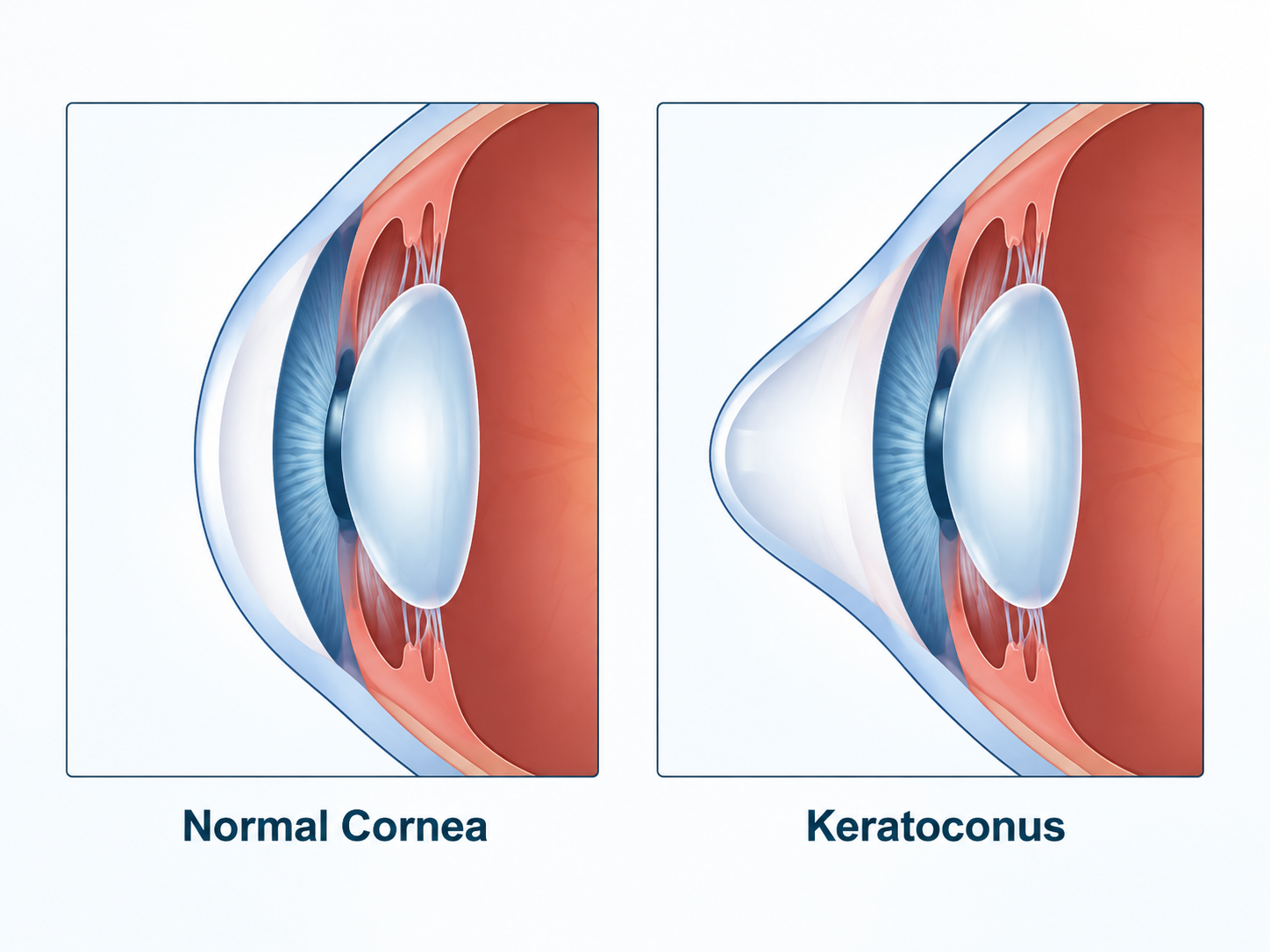
Keratoconus is a progressive eye condition that affects the cornea, the clear front surface of the eye. As the cornea becomes thinner and changes shape, vision may become blurred or distorted.
Keratoconus Treatment in Dombivli at Laxmi Eye Institute & Hospitals focuses on detailed corneal evaluation, early diagnosis, and personalised treatment based on the stage and progression of the condition.
Advanced corneal imaging and diagnostic technology help eye specialists understand changes in the shape and thickness of the cornea and recommend suitable treatment options.

What is Keratoconus?
Keratoconus is an eye condition in which the normally round cornea gradually becomes thin and develops a cone-like shape.
This irregular corneal shape prevents light from focusing properly on the retina, which can lead to blurred and distorted vision.
Keratoconus commonly:
- Begins during the teenage years or early adulthood
- May progress gradually over several years
- Can affect one or both eyes
- Causes irregular astigmatism
- May require frequent changes in spectacle power
- Can make vision correction with regular glasses difficult in advanced stages
Early evaluation can help identify progression and guide timely management.
Symptoms of Keratoconus
Keratoconus symptoms can vary depending on the severity and progression of the condition.
Common symptoms include:
- Blurred Vision – Objects may not appear clear even with spectacles.
- Distorted Vision – Straight lines or objects may appear irregular.
- Frequent Change in Spectacle Power – Prescription may change repeatedly.
- Increasing Astigmatism – Irregular corneal shape can increase cylindrical power.
- Sensitivity to Light – Bright lights may cause discomfort.
- Glare and Halos – Lights may appear scattered, especially at night.
- Difficulty with Night Vision – Driving or seeing in low-light conditions may become challenging.
Stages of Keratoconus
The severity of keratoconus depends on changes in corneal shape, thickness, and vision.
Early Keratoconus
- Mild changes occur in the shape of the cornea.
- Vision may still be corrected with spectacles or contact lenses.
- Regular monitoring helps identify progression.
Moderate Keratoconus
- Corneal irregularity becomes more noticeable.
- Astigmatism and blurred vision may increase.
- Specialised contact lenses or procedures may be considered.
Advanced Keratoconus
- Significant corneal thinning and distortion may occur.
- Spectacles may no longer provide adequate vision correction.
- Advanced treatment or corneal surgery may be required depending on the condition.
Keratoconus Examination Process & Advanced Technology
A detailed corneal examination helps determine the severity and progression of keratoconus.
| Visual Acuity Test | Checks how clearly the patient can see at different distances. |
|---|---|
| Refraction Test | Measures spectacle power and identifies irregular astigmatism. |
| Slit Lamp Examination | Allows detailed examination of the cornea and other eye structures. |
| Corneal Topography | Creates a detailed map of the corneal surface to identify irregularities. |
| Corneal Pachymetry | Measures corneal thickness and helps detect thinning. |
| Corneal Topography | Maps changes in the curvature and shape of the cornea. |
|---|---|
| Corneal Tomography | Provides detailed information about the front and back surfaces of the cornea. |
| Pachymetry | Measures corneal thickness at different points. |
| Advanced Corneal Imaging | Helps monitor changes and progression over time. |
Keratoconus Treatment Options in Dombivli
Treatment depends on the patient's age, vision, corneal thickness, severity, and whether keratoconus is progressing.
Spectacles and Contact Lenses
Spectacles – May provide adequate vision correction during the early stages.
Specialised Contact Lenses – Rigid gas permeable, scleral, or other specialised lenses may improve vision in patients with irregular corneas.
Corneal Cross-Linking (CXL)
Strengthens the Cornea – Cross-linking is performed to strengthen corneal tissue.
Helps Control Progression – The main aim is to slow or stop further progression of keratoconus.
Suitable for Selected Patients – Eligibility depends on corneal thickness, age, and progression.
Intracorneal Ring Segments
Small ring segments may be placed within the cornea in selected patients to improve its shape and reduce irregularity.
Corneal Transplant
In advanced keratoconus, where other treatment options cannot provide adequate vision or significant corneal scarring is present, corneal transplantation may be considered.
Benefits of Early Keratoconus Treatment
Early diagnosis and appropriate management can help protect long-term visual function.
- Early Detection of Progression – Helps identify worsening corneal changes.
- Better Vision Management – Suitable correction can improve visual quality.
- Helps Control Progression – Treatments such as corneal cross-linking may help stabilise progressive keratoconus.
- Regular Corneal Monitoring – Tracks changes in corneal shape and thickness.
- Personalised Treatment Planning – Treatment is selected according to the stage and individual eye condition.
Who Should Consider Keratoconus Evaluation?
A Keratoconus Evaluation in Dombivli may be recommended for:
Patients with Frequently Changing Spectacle Power – Repeated prescription changes may require further evaluation.
People with Increasing Astigmatism – Progressive cylindrical power can be associated with corneal irregularity.
Patients with Blurred or Distorted Vision – Especially when spectacles do not provide adequate correction.
People with a Family History of Keratoconus – Screening may help identify early corneal changes.
Patients with Excessive Eye Rubbing – Persistent eye rubbing is associated with keratoconus progression and should be avoided.
Young Patients with Rapid Vision Changes – Early corneal evaluation can help detect progressive disease.
Keratoconus Treatment Cost in Dombivli
The cost of Keratoconus Treatment in Dombivli depends on the severity of the condition, diagnostic tests required, and selected treatment approach.
Factors affecting treatment cost include:
- Stage of Keratoconus
- Corneal Topography or Tomography
- Type of Contact Lens Required
- Corneal Cross-Linking Procedure
- Intracorneal Ring Segments, if required
- Corneal Surgery, if required
- Follow-up and Monitoring
A detailed consultation at Laxmi Eye Institute & Hospitals helps determine the appropriate treatment plan and expected expenses.
Protect Your Vision with Keratoconus Treatment in Dombivli
Early evaluation and appropriate management help protect vision and control progression. Book your consultation at Laxmi Eye Institute & Hospitals for complete Keratoconus Treatment in Dombivli with advanced eye care support.
Why Choose Laxmi Eye Institute & Hospitals?
Experienced Eye Specialists: Comprehensive evaluation and management of corneal conditions.
Advanced Corneal Diagnostics: Modern imaging helps assess corneal shape, thickness, and progression.
Multiple Treatment Options: Care may include spectacles, specialised contact lenses, cross-linking, and surgical options when indicated.
Personalised Treatment Approach: Treatment planning is based on individual corneal findings and visual needs.
Regular Follow-up Care: Monitoring helps identify changes in keratoconus over time.
Frequently Asked Questions About Keratoconus Treatment in Dombivli
-
Q1. What is keratoconus?
Keratoconus is a condition in which the cornea becomes thinner and gradually develops an irregular cone-like shape, resulting in blurred or distorted vision.
-
Q2. Can keratoconus be treated?
Yes. Keratoconus can be managed using spectacles, specialised contact lenses, corneal cross-linking, intracorneal ring segments, or corneal surgery depending on its severity.
-
Q3. What is corneal cross-linking for keratoconus?
Corneal cross-linking is a procedure designed to strengthen the cornea and help slow or stop the progression of keratoconus.
-
Q4. How is keratoconus diagnosed?
Keratoconus is diagnosed through a detailed eye examination and tests such as corneal topography, tomography, and pachymetry.
-
Q5. Can glasses correct keratoconus?
Glasses may provide adequate vision correction in early keratoconus. As the condition progresses, specialised contact lenses may be required.
-
Q6. Does every keratoconus patient need surgery?
No. Treatment depends on the stage and progression of keratoconus. Many patients can be managed with vision correction, monitoring, or corneal cross-linking.
At Laxmi, the most trusted Eye hospital, we have a heritage of quality eye care spanning 3 decades and over 25 lakh satisfied patients. Our doctors are highly qualified and experienced super specialists, with most of them being fellowship-trained at eminent national and global institutions.
 Call
Call
All Copyright© Reserved @ Laxmi Eye Hospital And Institute